Stronger Body, Stronger Mind: Why CrossFit is Different
Chapter 3: How strength, intensity, skill, and constant variety each train the brain in a different way, and why the combination may matter most
Look at the whiteboard in a CrossFit gym on any given day and you’ll see something you won’t see in most fitness programs: it’s different from yesterday. Heavy squats on Monday. A 15-minute workout of rowing, burpees, and kettlebell swings on Tuesday. Handstand practice and short, nasty sprints on Wednesday. Ask someone what they’re training for and the honest answer is often “whatever shows up.”
In the first two chapters, we looked at what exercise in general does for the brain: the molecules your muscles release, and the way training reshapes your stress hormones, mood chemistry, inflammation, gut, and sleep. Nearly all of that applies to any kind of regular exercise. So it’s fair to ask: is there anything about this kind of training that matters?
I spent my career as a scientist, and the first thing I’d want to know is what the evidence actually says. So let’s start there.
A Quick Word on the Evidence
A June 2026 systematic review examined 13 studies involving more than 3,200 participants, including nearly 2,800 CrossFit athletes. The researchers found that CrossFit participation was associated with high intrinsic motivation, enjoyment of personal challenges, emotional self-efficacy, and positive social connections. They concluded that while research specifically on CrossFit's psychological benefits is growing, the evidence remains preliminary.¹
What we do have is a large body of research on the individual ingredients of CrossFit-style training: lifting heavy things, working at high intensity, learning complex skills, and constantly changing the challenge. Each of those has its own evidence, and each one appears to train the brain in a slightly different way. That’s the approach this chapter takes. We’ll look at what each piece does and why putting them together may be especially good at building resilience.
Strength: More Than Muscle
For a long time, the brain benefits of exercise were credited almost entirely to “cardio.” Lifting was for muscles. That view hasn’t held up.
A large 2018 analysis of 36 studies in adults over 50 found that exercise improved cognitive function, and that both aerobic training and resistance training worked, as did programs combining the two.² In one of the clearest trials, women aged 65 to 75 who did resistance training once or twice a week for a year improved on a test of executive function, the mental skills that let you focus, ignore distractions, and switch between tasks, by roughly 11 to 13%. A comparison group doing balance and toning exercises did not improve.³
The most striking evidence comes from the SMART trial, which put older adults with mild cognitive impairment, often an early warning sign of dementia, through six months of high-intensity resistance training. Their overall cognitive function improved.⁴ When researchers dug into the data, they found something important: the people who gained the most strength showed the biggest cognitive improvements.⁵ It wasn’t just showing up to the gym that mattered. Getting stronger did.
Lifting also helps with mood. In Chapter 2, we saw that resistance training reduces symptoms of depression. A separate analysis of randomized trials found it also significantly reduces anxiety symptoms.⁶
Intensity: Practicing Discomfort
The second ingredient is intensity. CrossFit workouts are often short and hard, and that’s not just a matter of style. It changes what the body and brain are exposed to.
In Chapter 1, we met BDNF, the “fertilizer” molecule that supports learning and memory. When researchers compared 20 minutes of steady, hard cycling with 20 minutes of intervals (one minute very hard, one minute of rest), both raised BDNF, but the intervals raised it slightly more. And nearly three out of four participants said they preferred the intervals.⁷ That last detail matters more than it might seem. The workout people prefer is the one they keep doing.
But the more interesting effect of intensity may be psychological. A pounding heart, heavy breathing, and burning muscles feel a lot like the physical symptoms of anxiety. For people who are frightened by those sensations, a condition psychologists call high anxiety sensitivity, that overlap can be the problem in itself.
In one study, researchers had people with high anxiety sensitivity do six 20-minute treadmill sessions at either low or high intensity. Both groups improved, but the high-intensity group improved faster, and only the high-intensity group showed a reduced fear of the body sensations that come with anxiety.⁸ In other words, repeatedly experiencing a racing heart in a safe setting taught the brain that those sensations aren’t dangerous.
This connects to an idea from Chapter 2: practicing with physical stress seems to make you more resilient to stress that has nothing to do with the gym. High-intensity training is a concentrated dose of that practice. You get very uncomfortable, you stay with it for a few minutes, and then it ends and you recover. Do that a few times a week, and “uncomfortable” stops feeling like “emergency.”
One caveat belongs here. Intensity is a tool, not a goal in itself, and more is not automatically better. The same 2021 review of CrossFit research noted reports of exercise addiction and competition-related anxiety in some athletes.¹ The benefits come from a dose your body can recover from.
Skill: Learning Changes the Brain
A lot of CrossFit isn’t only about working hard at all. It’s about learning to do something you couldn’t do before: a clean, a double-under, a kipping pull-up, a handstand. Those movements take months or years to learn, and the learning itself appears to change the brain.
In a well-known study, adults who had never juggled spent three months learning a three-ball routine. Brain scans showed that gray matter grew in areas that process visual motion. When they stopped practicing for three months, that growth partly reversed.⁹ The brain physically adapts to the skills you ask it to learn, and it starts to let go when you stop. “Use it or lose it” applies to the brain as much as the body.
Psychologist Adele Diamond, one of the leading researchers on executive function, reviewed the evidence on what actually improves these mental skills. Her conclusion was that the activities with the best results tend to be the ones that keep challenging people and demand real attention, rather than exercise done on autopilot.¹⁰ Learning a complex lift, coordinating a gymnastics movement, or figuring out how to pace a workout you’ve never seen is exercise that requires thinking.
Variety: Why Novelty Matters
The last ingredient is the one CrossFit is best known for: constant varied. You rarely do the same workout twice, and you often don’t know what’s coming until you walk in.
Some of the most interesting evidence for why this might matter comes from animal research, so it comes with the usual caution. In a classic experiment, mice that lived in an “enriched” environment, with toys, tunnels, and new things to explore, grew more new neurons in the hippocampus than mice in standard cages.¹¹ Later research found that running alone also increases new neurons, but by a different route. Running mainly increased how many new brain cells were produced. Novelty and exploration mainly helped those new cells survive. When mice ran first and then lived in an enriched environment, the boost in new neurons was about 30% larger than either one alone.¹²
We can’t measure new neurons in a living human brain the same way, so we can’t say for certain that this holds in people. But it fits with what we see elsewhere: physical effort and mental novelty seem to work through different mechanisms, and they appear to add together rather than overlap.
There’s also a practical side to variety that has more to do with life than with neurons. Real-world stress doesn’t arrive on a schedule. It shows up unannounced, in a form you didn’t plan for. Training that regularly asks you to handle something unfamiliar, to adjust a weight, scale a movement, or pace an unknown effort, is practice for exactly that.
Putting It Together
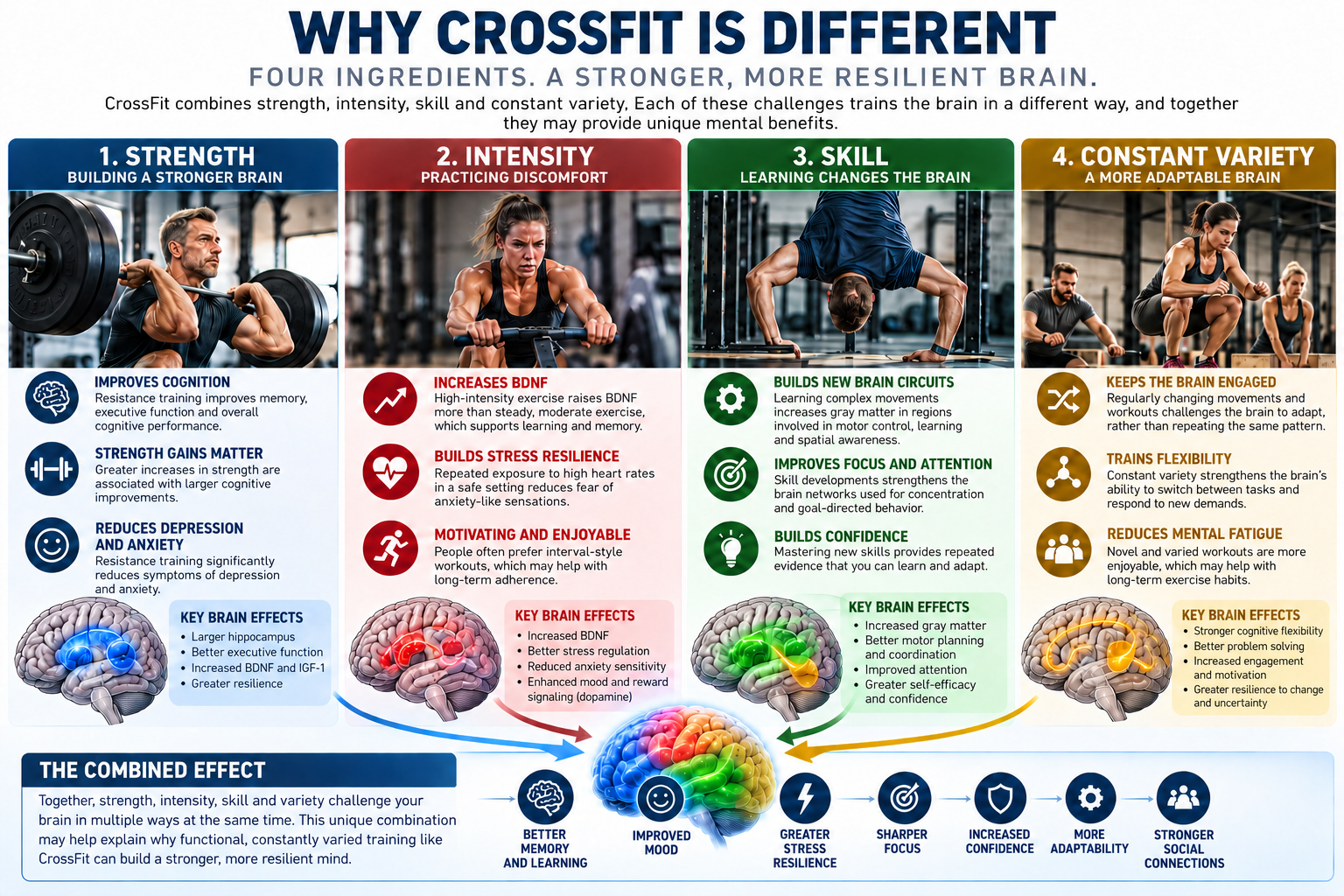
CrossFit’s own definition is “constantly varied functional movements performed at high intensity.” That’s a description of a program that combines all four of the ingredients above in a single hour: strength, intensity, skill, and novelty.
The word functional is worth a moment, too. Squatting, deadlifting, carrying, pushing, and getting up off the floor are the movements of daily life. In the year-long strength study described earlier, women whose executive function improved also tended to walk faster, a reminder that how well the brain works and how well the body moves in the real world are closely tied.³
Does the combination matter more than the individual pieces? That hasn’t been directly tested in a large trial. But there is one small study worth mentioning. Researchers randomly assigned 23 previously inactive adults to eight weeks of either CrossFit-style training or a traditional program of moderate cardio plus weights. The CrossFit group maintained a higher exercise enjoyment relative to the traditional program and more of them said they planned to keep going afterward.¹³ The researchers suggested that workout variety, self-selected intensity, and enjoyment may contribute to the appeal of high-intensity functional training. It points to something important: the best program for your brain is one you’ll actually stick with for years!
The Big Picture
In Chapters 1 and 2, we saw that exercise in general sends a network of signals to the brain. This chapter suggests that the kind of training you do may shape which parts of that network get the most use:
- Strength improves memory and executive function, and gaining strength appears to matter, not just showing up
- Intensity raises BDNF and teaches your brain that a racing heart and heavy breathing aren’t an emergency
- Skill practice physically changes the brain, and challenging, attention-demanding exercise appears to sharpen thinking more than training on autopilot
- Variety may add a separate benefit, with novelty helping new brain cells survive
- The combination gives your brain repeated, controlled practice at handling stress it didn’t see coming
That’s what resilience really is: not avoiding stress, but getting better at absorbing it and recovering. A program built on constant variety and controlled intensity is practice at exactly that.
There’s one more ingredient we haven’t talked about yet, and it might be the most powerful of all. CrossFit isn’t usually done alone. It’s done in a room full of people, at the same time, on the same workout. In the next chapter, we’ll look at why that may matter as much as anything we’ve covered so far.
Next in the series: Chapter 4, “Community Is Medicine,” on why training alongside people who support you is a powerful and often overlooked benefits of CrossFit.
Back to Stronger Body, Stronger Mind Prologue
References
- de Oliveira, H. S., Dominski, F. H., Truppel, R., D’Oliveira, A., & Andrade, A. (2026). Psychological variables of CrossFit participants: An up-to-date systematic review. Frontiers in Sports and Active Living, 8, 1870064.
- Northey, J.M., Cherbuin, N., Pumpa, K.L., Smee, D.J., & Rattray, B. (2018). Exercise interventions for cognitive function in adults older than 50: a systematic review with meta-analysis. British Journal of Sports Medicine, 52(3), 154–160.
- Liu-Ambrose, T., Nagamatsu, L.S., Graf, P., Beattie, B.L., Ashe, M.C., & Handy, T.C. (2010). Resistance training and executive functions: a 12-month randomized controlled trial. Archives of Internal Medicine, 170(2), 170–178.
- Fiatarone Singh, M.A., et al. (2014). The Study of Mental and Resistance Training (SMART) study—resistance training and/or cognitive training in mild cognitive impairment: a randomized, double-blind, double-sham controlled trial. Journal of the American Medical Directors Association, 15(12), 873–880.
- Mavros, Y., et al. (2017). Mediation of cognitive function improvements by strength gains after resistance training in older adults with mild cognitive impairment: outcomes of the Study of Mental and Resistance Training. Journal of the American Geriatrics Society, 65(3), 550–559.
- Gordon, B.R., McDowell, C.P., Lyons, M., & Herring, M.P. (2017). The effects of resistance exercise training on anxiety: a meta-analysis and meta-regression analysis of randomized controlled trials. Sports Medicine, 47(12), 2521–2532.
- Saucedo Marquez, C.M., Vanaudenaerde, B., Troosters, T., & Wenderoth, N. (2015). High-intensity interval training evokes larger serum BDNF levels compared with intense continuous exercise. Journal of Applied Physiology, 119(12), 1363–1373.
- Broman-Fulks, J.J., Berman, M.E., Rabian, B.A., & Webster, M.J. (2004). Effects of aerobic exercise on anxiety sensitivity. Behaviour Research and Therapy, 42(2), 125–136.
- Draganski, B., Gaser, C., Busch, V., Schuierer, G., Bogdahn, U., & May, A. (2004). Neuroplasticity: changes in grey matter induced by training. Nature, 427(6972), 311–312.
- Diamond, A., & Ling, D.S. (2016). Conclusions about interventions, programs, and approaches for improving executive functions that appear justified and those that, despite much hype, do not. Developmental Cognitive Neuroscience, 18, 34–48.
- Kempermann, G., Kuhn, H.G., & Gage, F.H. (1997). More hippocampal neurons in adult mice living in an enriched environment. Nature, 386(6624), 493–495.
- Fabel, K., Wolf, S.A., Ehninger, D., Babu, H., Leal-Galicia, P., & Kempermann, G. (2009). Additive effects of physical exercise and environmental enrichment on adult hippocampal neurogenesis in mice. Frontiers in Neuroscience, 3, 50.
- Heinrich, K.M., Patel, P.M., O’Neal, J.L., & Heinrich, B.S. (2014). High-intensity compared to moderate-intensity training for exercise initiation, enjoyment, adherence, and intentions: an intervention study. BMC Public Health, 14, 789.
MORE RECENT POSTS