The Stronger Body, Stronger Mind: Your Muscles are Talking to Your Brain
Chapter 1. The Muscle-BrAIN Axis
Have you ever heard people say that CrossFit does more for their mind than their body??
I used to chalk that up to confidence, or community, or just feeling less stressed after a good sweat. All real things — and we’ll get to them later in the series. But it turns out something is also happening at a much smaller scale, one you can’t see or feel: your muscles are having a full biochemical conversation with your brain, every single time you train.
That’s not a metaphor. It’s actual biology, and scientists have only really understood it in the last couple of decades.
Your Muscles Aren’t Just for Lifting Things
Growing up, you probably learned that muscles have one job: move your body. Pick up a barbell, climb the stairs, sprint 200 meters. That’s true, but it turns out to be the smaller part of the story.
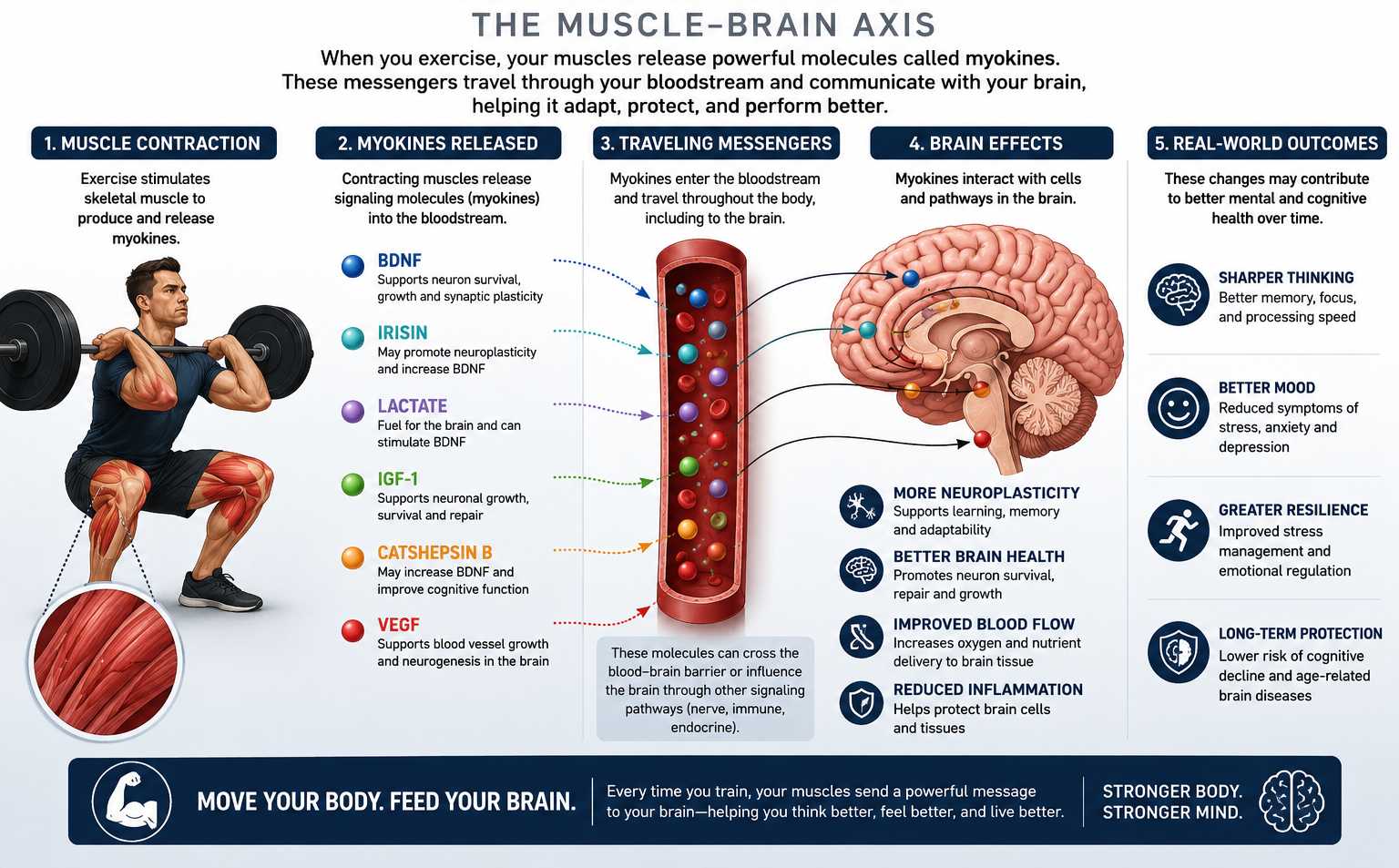
When your muscles contract — especially under real effort, like a heavy set of squats or the third round of “Fran” — they release a flood of molecules into your bloodstream. Scientists call these myokines, and they act like text messages your muscles are sending to the rest of your body: your liver, your fat tissue, your immune system, and, importantly for us, your brain.
A 2025 scientific review by researchers Wilfredo López-Ojeda and Robin Hurley gave this whole communication system a name: the muscle–brain axis. In plain English, it works like this:
- You train, and your muscles contract hard.
- That effort triggers the release of signaling molecules.
- Some of those molecules travel through your blood and reach your brain.
- Your brain responds — literally changing its own chemistry and structure.
We’ve known for a long time, just from watching people, that exercise is good for the brain: better mood, sharper memory, more resilience to stress. What’s new is that researchers are starting to figure out why — and a surprising amount of the answer starts in your muscles, not your head.
Here are a few of the most interesting messengers in that conversation.
BDNF: Fertilizer for Your Brain
The molecule researchers have studied the most is BDNF (brain-derived neurotrophic factor). Some scientists nickname it “Miracle-Gro for the brain,” because it helps brain cells survive, grow new connections, and strengthen the ones they already have. That process — your brain’s ability to rewire and adapt — is called neuroplasticity, and it’s the foundation of learning and memory.
Here’s the well-established part: a single hard workout reliably produces a temporary spike in BDNF, especially at moderate-to-vigorous intensity — think a workout that actually challenges you, not a stroll on the treadmill. So that class where you’re breathing hard and your legs are burning isn’t just building fitness. At the same time, you’re switching on a pathway tied directly to your brain’s ability to learn and adapt.
Irisin: The Messenger Muscles Send to the Brain
Irisin is a myokine produced when your muscles ramp up a protein called FNDC5 during exercise. What makes irisin interesting is that it can travel to the brain and interact with the same systems as BDNF.
Some of the clearest evidence comes from mouse studies, where blocking this pathway impairs memory, and restoring it protects memory — including in mice with Alzheimer’s-like brain changes.¹ Other work has shown that irisin itself, applied to hippocampal brain cells, boosts BDNF release and protects those cells from stress.²
Human research on irisin and cognition is newer and still developing. But the animal data is compelling enough that several research groups are actively chasing this pathway as a possible reason exercise protects the aging brain.
Lactate: Not the Enemy You Were Taught It Was
If you’ve been training for a while, you were probably taught that the burn in your legs during a tough set of thrusters is “lactic acid,” and that it’s basically muscular exhaust — a waste product your body needs to clear out. That explanation is outdated.
We now know lactate is actually a valuable fuel source and a signaling molecule in its own right. During intense efforts, your muscles produce large amounts of it, and instead of being garbage, it gets shuttled around your body — including to your brain, where neurons can burn it directly for energy. On top of that, lactate appears to activate some of the same pathways as BDNF, tied to learning and memory.³
So the next time your legs are on fire in the final round of a workout, that’s not a sign something’s going wrong. It’s part of a sophisticated fuel-and-messaging system, and your brain is one of the places that message is headed.
Cathepsin B: A Newer Discovery With Real Human Data
Cathepsin B (CTSB) is a more recent addition to this list, and one of the few myokines with solid human evidence behind it — not just animal studies.
In one study, healthy middle-aged adults who trained consistently over time showed measurable improvements in memory, alongside changes in circulating CTSB.⁴ Another study of older adults at risk for Alzheimer’s found that a structured aerobic training program raised CTSB levels, and those changes tracked with better cognitive performance.⁵ Original animal work identified CTSB as a muscle-released signal tied to hippocampal memory function after running.⁶
The picture isn’t finished — some studies show CTSB rising with training, others show more complicated patterns depending on age and training history. But CTSB is a good example of how this field keeps turning up new muscle-to-brain messengers that scientists didn’t expect a decade ago.
IGF-1 and VEGF: Building and Feeding the Brain
Two more players are worth knowing about.
IGF-1 (insulin-like growth factor 1) gets talked about mostly for muscle growth, but it also plays a real role in how neurons grow, survive, repair themselves, and form new connections. It works alongside BDNF rather than on its own — these systems talk to each other constantly.
VEGF (vascular endothelial growth factor) is best known for building blood vessels. In the brain, that matters because more blood flow to regions like the hippocampus — your brain’s memory center — supports the growth of new brain cells. The human evidence connecting a workout’s VEGF response directly to brain changes is still early, but it’s another plausible thread in the same rope.
The Real Takeaway: It’s a Network, Not a Switch
No single molecule explains why exercise is good for your brain. BDNF, irisin, lactate, CTSB, IGF-1, VEGF, and others all overlap and reinforce each other. Several of them boost BDNF directly. Others affect blood flow, inflammation, energy supply, or the brain’s ability to grow new cells.
Exercise doesn’t flip one “brain health switch.” It turns on an entire network — all at once, every time you train hard. That’s also why scientists have struggled for years to point to one single mechanism behind exercise’s mental benefits. There probably isn’t one. There are dozens, working together, most of them starting in your muscles.
Where This Leaves Us
A hard workout clearing your head, better sleep after a tough training week, that lift in mood after class — none of that is new information to anyone who trains. What the science is doing is filling in why, and the answer starts somewhere most people would never think to look: the muscle itself, sending signals to the brain in real time.
We’ll dig into a few of the other biological systems exercise touches — stress hormones, dopamine, sleep, inflammation — in the next chapter. And later in this series, we’ll come back to why CrossFit specifically, with its mix of heavy lifting, gymnastics, and high-intensity intervals, may be particularly good at flipping on this whole network at once.
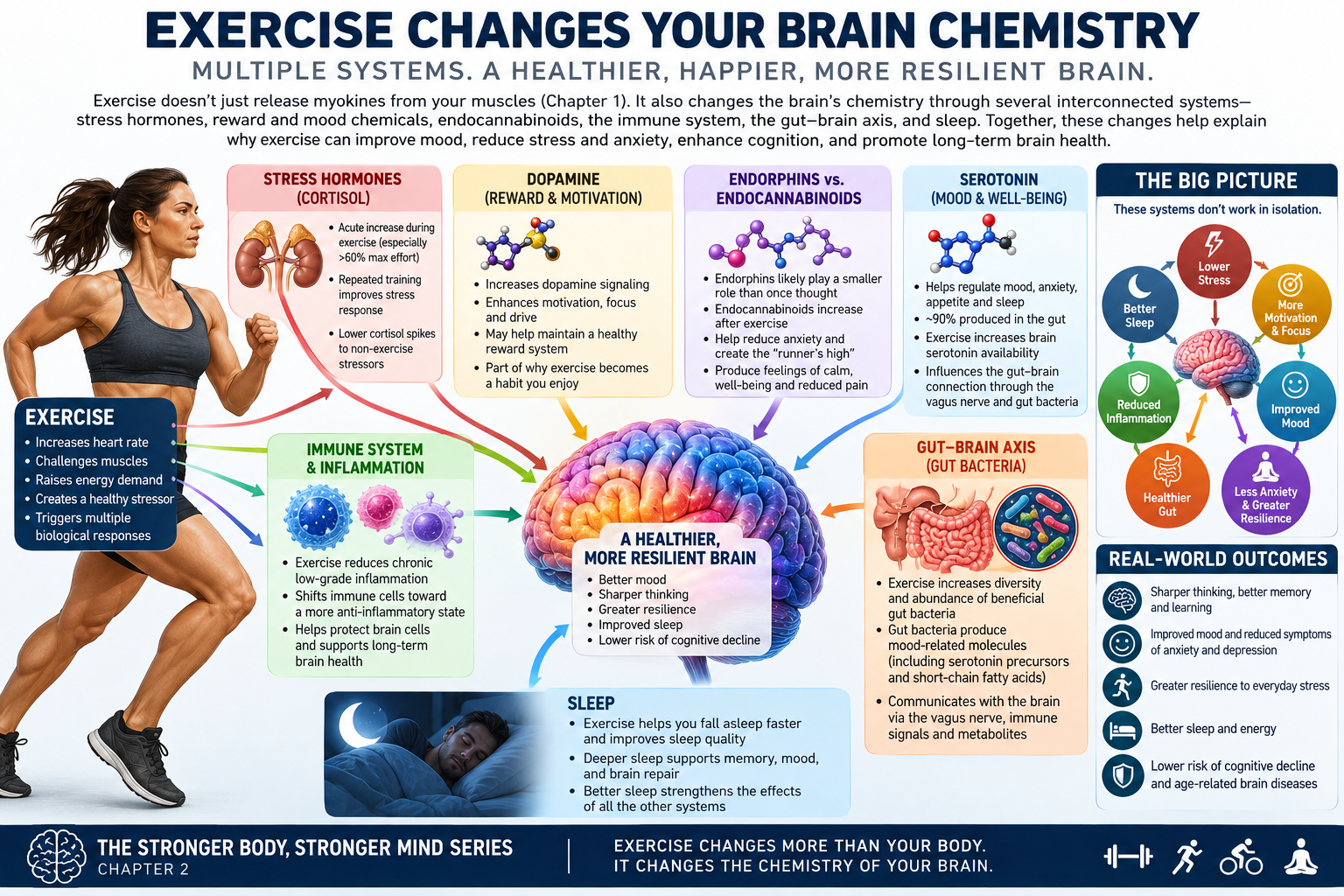
Next in the series: Chapter 2, “Exercise Changes Your Brain Chemistry” — how training affects cortisol, dopamine, serotonin, inflammation, sleep, and more.
Back to Stronger Body, Stronger Mind Prologue
References
- Lourenco, M.V., et al. (2019). Exercise-linked FNDC5/irisin rescues synaptic plasticity and memory defects in Alzheimer’s models. Nature Medicine, 25, 165–175.
- Islam, M.R., et al. (2021). Exercise hormone irisin is a critical regulator of cognitive function. Nature Metabolism (see also: Wrann, C.D., et al. (2013). Exercise induces hippocampal BDNF through a PGC-1α/FNDC5 pathway. Cell Metabolism, 18(5), 649–659.)
- Margineanu, M.B., Mahmood, H., Fiumelli, H., & Magistretti, P.J. (2018). L-lactate regulates the expression of synaptic plasticity and neuroprotection genes in cortical neurons: a transcriptome analysis. Frontiers in Molecular Neuroscience, 11, 375.
- Moon, H.Y., et al. (2019). Long-term exercise training improves memory in middle-aged men and modulates peripheral levels of BDNF and Cathepsin B. Scientific Reports, 9, 3337.
- Gaitán, J.M., et al. (2021). Effects of Aerobic Exercise Training on Systemic Biomarkers and Cognition in Late Middle-Aged Adults at Risk for Alzheimer’s Disease. Frontiers in Endocrinology, 12.
- Moon, H.Y., et al. (2016). Running-induced systemic cathepsin B secretion is associated with memory function. Cell Metabolism, 24(2), 332–340.
- López-Ojeda, W., & Hurley, R.A. (2025). Myokines and the Brain: A Novel Neuromuscular Endocrine Loop. The Journal of Neuropsychiatry and Clinical Neurosciences, 37(1), A4-4.
MORE RECENT POSTS