Stronger Body, Stronger Mind: How Exercise Changes Your Brain Chemistry
Chapter 2. How training reshapes your stress response, mood, gut, and sleep, and why the "runner's high" isn't what you think
Ask anyone who trains why they keep showing up, and sooner or later you’ll hear some version of the same answer: “It’s the best part of my day.” Not the best workout of the day. The best part of the day.
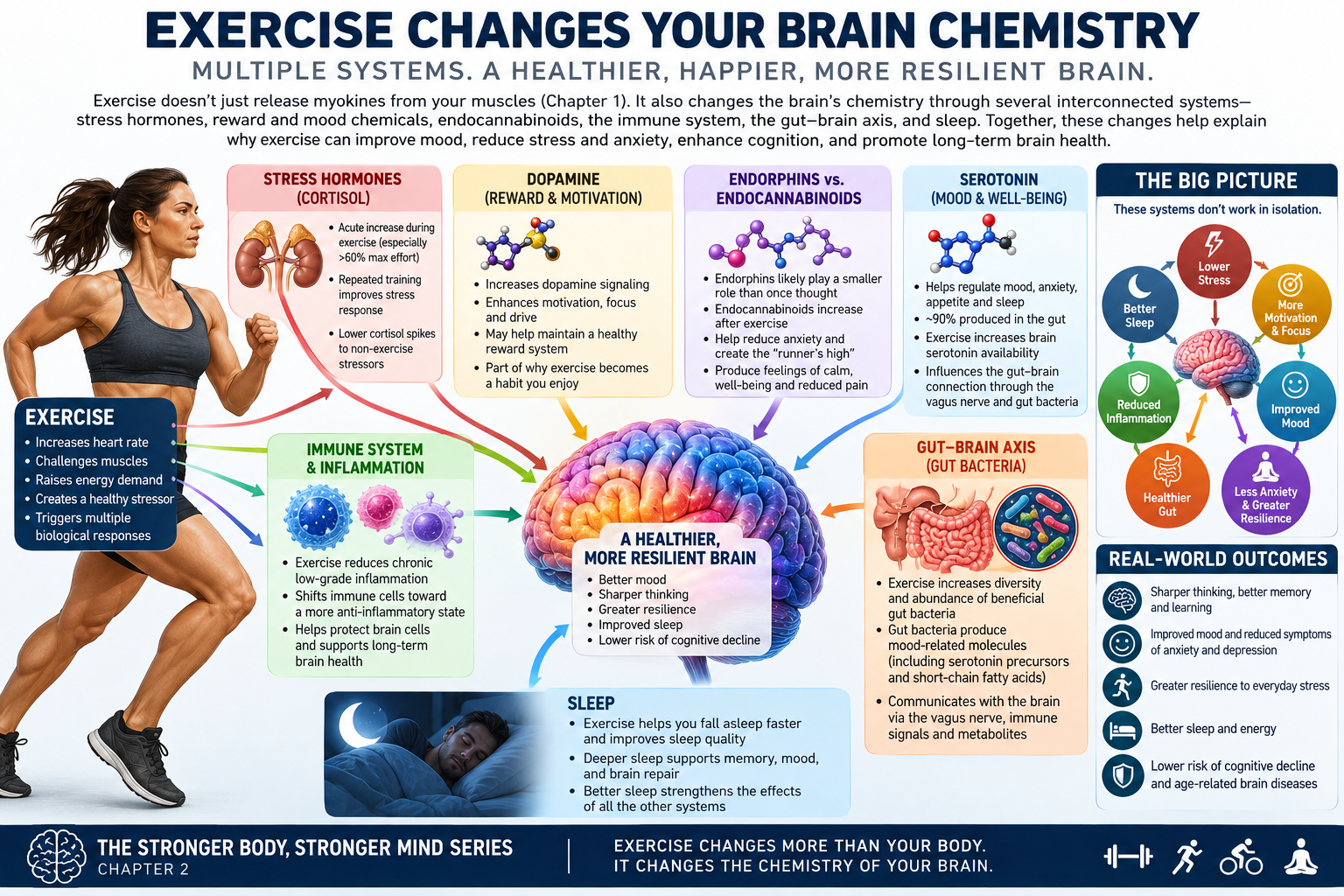
I hear it constantly, and I don’t think people are only talking about their squat numbers. They’re talking about how they feel walking out the door. In Chapter 1, we saw how working muscles release molecules that travel to the brain. This chapter zooms out. Exercise also changes the brain’s chemistry through several other systems at once: your stress hormones, your reward and mood chemicals, your immune system, the bacteria in your gut, and the quality of your sleep.
None of these work alone, and each one feeds the others. Let’s take them one at a time.
Cortisol: Training Your Stress Response
Cortisol is your body’s main stress hormone. It gets a bad reputation, but you need it. It wakes you up in the morning, mobilizes energy when you need it, and helps you respond to a threat. The problem isn’t cortisol itself. It’s cortisol that stays high for too long, which is linked to poor sleep, low mood, and worse memory.
Here’s the part that surprises people: a hard workout raises cortisol. Research shows there’s an intensity threshold, and once you’re working above roughly 60% of your maximum aerobic capacity, cortisol climbs.¹ So that brutal 20-minute AMRAP is, biologically speaking, a stressor.
That’s exactly the point. Every time you train, you’re giving your stress system a controlled dose of pressure, followed by recovery. Do that week after week, and the system gets better at handling it. In one well-known study, researchers put trained and untrained men through a standardized stress test: public speaking and mental math in front of a stone-faced panel. The trained men had smaller cortisol spikes, lower heart rates, and reported feeling calmer and in a better mood than the untrained men.²
Scientists call this idea cross-stressor adaptation: practicing with physical stress seems to make you more resilient to stress that has nothing to do with the gym. The deadline at work, the argument at home, the traffic. Your body doesn’t fully distinguish between them, and it’s been rehearsing.
Dopamine: Why You Keep Coming Back
Dopamine is often called the “pleasure chemical,” but that undersells it. It’s really about motivation, reward, and drive: the signal that says that was worth it, do it again. It’s also central to focus and movement.
Exercise boosts dopamine signaling, and much of the most detailed evidence comes from animal studies, where regular running reshapes the brain’s reward circuits. Human data is harder to collect, because measuring dopamine in a living brain requires specialized brain scans. One striking example comes from people in recovery from methamphetamine addiction, a drug that badly damages the dopamine system. After eight weeks of structured exercise training, participants showed a measurable increase in dopamine receptor availability in a key reward region of the brain, while a comparison group that didn’t exercise did not.³
That’s a special population, so we shouldn’t overstate it. But it fits with what researchers see elsewhere: exercise appears to help keep the brain’s reward system tuned and responsive. It may also be part of why training becomes a habit people genuinely look forward to, rather than a chore they have to force.
The “Runner’s High” Isn’t What You Think
For decades, the feel-good rush after a hard effort was credited to endorphins, the body’s natural opioids. It’s one of the most repeated facts in fitness, and it turns out to be shaky.
In a 2021 study, researchers gave participants either a placebo or naltrexone, a drug that blocks the body’s opioid receptors, and then had them run for 45 minutes. If endorphins were the cause, blocking them should have blocked the high. It didn’t. Both groups felt the same lift in mood and the same drop in anxiety.⁴
The more likely culprit is the endocannabinoid system: molecules your body produces naturally that act on the same receptors as compounds in cannabis. Levels of these molecules rose after the run in both groups, and they’re now the leading explanation for that calm, happy, slightly floaty feeling after a big workout. Endorphins may still play some role, but they’re probably not the main act.
Serotonin: Mood, and a Surprising Twist
Serotonin helps regulate mood, anxiety, appetite, and sleep. It’s the system targeted by the most common class of antidepressants, so it’s natural to ask whether exercise works through it too.
Here’s the twist: roughly 90% of your body’s serotonin isn’t made in your brain at all. It’s made in your gut, and research shows that gut bacteria play a big role in controlling how much gets produced.⁵ Gut serotonin can’t cross directly into the brain, but it influences digestion, the immune system, and the nerve signals that run from the gut to the brain. We’ll come back to the gut in a moment.
Exercise also affects mood chemistry through a pathway that ties right back to Chapter 1. When you’re under chronic stress, your body produces more of a substance called kynurenine, which can enter the brain and is linked to depression. In a landmark 2014 study, researchers found that trained muscle produces enzymes that convert kynurenine into a form that can’t get into the brain. Mice with “trained” muscle were protected from stress-induced depression, and human muscle showed the same enzymes ramping up after endurance training.⁶ In other words, your muscles can help filter a stress-related chemical out of your blood before it reaches your head.
The bottom line on mood is backed by strong human evidence. A 2024 analysis pooling more than 200 clinical trials found that exercise meaningfully reduced symptoms of depression, with walking or jogging, yoga, and strength training among the most effective options, and greater benefits at higher intensities.⁷ An earlier analysis focused specifically on resistance training found that lifting reduced depressive symptoms regardless of a person’s health status or how much total training they did.⁸
Exercise is not a replacement for professional care when someone needs it. But the evidence that it’s a real, effective part of the picture is about as solid as exercise science gets.
Inflammation: Turning Down the Background Noise
You know inflammation as the swelling around a sprained ankle. That kind is short-term and useful. The kind that matters for the brain is different: low-grade, chronic inflammation that simmers quietly in the background for months or years. It’s linked to heart disease and diabetes, and increasingly to depression, fatigue, and brain fog.
Regular exercise is one of the most reliable ways to turn that background noise down.⁹ Part of the reason is a molecule we could have included in Chapter 1: interleukin-6 (IL-6). When your muscles work hard, they release large amounts of IL-6 into your blood. In that context, it acts as a signal that triggers the release of anti-inflammatory molecules and suppresses inflammatory ones. In one experiment, a few hours of cycling largely blocked the spike in a key inflammatory molecule that normally follows exposure to a bacterial toxin.¹⁰ Over time, regular training also reduces belly fat (a major source of inflammatory signals) and improves how the immune system is regulated.
Why does this matter for your mood? When the body is inflamed, the immune system sends signals to the brain that can produce what researchers call “sickness behavior”: low energy, poor sleep, loss of interest, and withdrawing from people. If you’ve ever felt flat and unmotivated while fighting off a cold, you’ve experienced a short version of it.¹¹ Chronic, low-grade inflammation can produce a quieter, longer-lasting version. Bringing inflammation down removes one of the forces dragging mood and motivation in the wrong direction.
Your Gut: The Second Conversation
In Chapter 1, we described the conversation between your muscles and your brain. There’s a second one happening at the same time, between your gut and your brain, and exercise is part of it.
Your digestive tract is home to trillions of bacteria, collectively called the gut microbiome. They help digest food, train your immune system, and produce compounds that influence inflammation and even brain chemistry. That communication network is called the gut–brain axis.
The evidence that exercise reshapes this community is growing:
- A study of professional rugby players found they had a more diverse gut microbiome than non-athletes, though their very different diets were part of the story.¹²
- To separate exercise from diet, researchers had previously sedentary adults do six weeks of supervised training while keeping their diets steady. Their gut bacteria shifted, and in lean participants, levels of short-chain fatty acids rose. These are beneficial compounds bacteria produce that help keep the gut lining healthy and inflammation in check. When participants stopped training for six weeks, most of those changes faded.¹³
- One of the more remarkable findings ties back to lactate. Researchers studying marathon runners found that a type of bacteria called Veillonella surged after a race. These bacteria feed on lactate that makes its way into the gut. When the bacteria were given to mice, the mice ran longer on a treadmill.¹⁴
That last one is a great reminder that the lactate your muscles produce isn’t just waste. It feeds your brain, and apparently some of your gut bacteria, too.
How does this connect to mood? A large study of more than 1,000 people found that two groups of gut bacteria were consistently depleted in people with depression, one of them a producer of butyrate, a beneficial short-chain fatty acid.¹⁵ We are not yet at the point where anyone can say, “Exercise changes your gut bacteria, which improves your mood,” in a straight line. That connection in humans is still being worked out. But the pieces are lining up: exercise shifts the microbiome, the microbiome influences inflammation and brain chemistry, and both of those affect how you feel.
One honest caveat: more isn’t always better here. Extremely long or intense endurance efforts can temporarily stress the gut. For most people training a few times a week, though, the direction of the evidence is positive.
Sleep: Where It All Comes Together
If you’ve ever slept like a rock after a tough training day, you already know this part. The research backs you up. A large review of studies found that a single bout of exercise modestly improves several measures of sleep, including total sleep time and how quickly you fall asleep, and that regular exercise produces small-to-moderate improvements in overall sleep quality.¹⁶
What about the people who train in the evening? A common worry is that a late workout will leave you too wired to sleep. A review of the evidence found that evening exercise generally doesn’t hurt sleep, and may even slightly improve deep sleep. The one exception: very vigorous sessions that end within about an hour of bedtime can make it harder to fall asleep.¹⁷ So the 7 p.m. class is fine. A max-effort workout at 10:30 p.m. right before lights out might not be.
Sleep matters so much here because it’s when your brain does its maintenance. Research in mice showed that during sleep, the space between brain cells expands and fluid flushes through, clearing out metabolic waste, including proteins associated with Alzheimer’s disease, much faster than during waking hours.¹⁸ Sleep is also when memories get consolidated, when stress hormones reset, and when the brain recovers from the day.
That’s why sleep belongs at the end of this chapter. Better sleep lowers cortisol. Lower cortisol and lower inflammation improve sleep. Better mood makes it easier to train. Training improves all of the above. These systems form a loop, and exercise is one of the few things that pushes on every part of it at once.
The Big Picture
In Chapter 1, the takeaway was that exercise turns on a network of signals from your muscles, not a single switch. This chapter shows that the network is even bigger than that. A hard workout:
- Gives your stress system practice, so real-life stress hits a little softer
- Keeps your reward and motivation circuits responsive
- Releases endocannabinoids that produce that post-workout calm
- Helps your muscles filter out stress-related chemicals linked to depression
- Turns down chronic inflammation
- Shifts the bacteria in your gut toward a healthier mix
- Improves your sleep, which reinforces everything else
That’s a lot happening under the surface of one class. So the next time someone says training is the best part of their day, they’re not exaggerating. There’s a lot of biology behind that feeling.
So far in this series, we’ve focused on what exercise in general does for the brain. In the next chapter, we’ll get specific: what makes CrossFit’s mix of strength, intensity, skill, and constant variety different, and why that combination may be especially good at building resilience.
Next in the series: Chapter 3, “Why CrossFit Is Different,” on how varied, challenging training builds resilience.
Back to Stronger Body, Stronger Mind Prologue
References
- Hill, E.E., Zack, E., Battaglini, C., Viru, M., Viru, A., & Hackney, A.C. (2008). Exercise and circulating cortisol levels: the intensity threshold effect. Journal of Endocrinological Investigation, 31(7), 587–591.
- Rimmele, U., et al. (2007). Trained men show lower cortisol, heart rate and psychological responses to psychosocial stress compared with untrained men. Psychoneuroendocrinology, 32(6), 627–635.
- Robertson, C.L., et al. (2016). Effect of exercise training on striatal dopamine D2/D3 receptors in methamphetamine users during behavioral treatment. Neuropsychopharmacology, 41(6), 1629–1636.
- Siebers, M., et al. (2021). Exercise-induced euphoria and anxiolysis do not depend on endogenous opioids in humans. Psychoneuroendocrinology, 126, 105173.
- Yano, J.M., et al. (2015). Indigenous bacteria from the gut microbiota regulate host serotonin biosynthesis. Cell, 161(2), 264–276.
- Agudelo, L.Z., et al. (2014). Skeletal muscle PGC-1α1 modulates kynurenine metabolism and mediates resilience to stress-induced depression. Cell, 159(1), 33–45.
- Noetel, M., et al. (2024). Effect of exercise for depression: systematic review and network meta-analysis of randomised controlled trials. BMJ, 384, e075847.
- Gordon, B.R., et al. (2018). Association of efficacy of resistance exercise training with depressive symptoms: meta-analysis and meta-regression analysis of randomized clinical trials. JAMA Psychiatry, 75(6), 566–576.
- Gleeson, M., et al. (2011). The anti-inflammatory effects of exercise: mechanisms and implications for the prevention and treatment of disease. Nature Reviews Immunology, 11(9), 607–615.
- Starkie, R., Ostrowski, S.R., Jauffred, S., Febbraio, M., & Pedersen, B.K. (2003). Exercise and IL-6 infusion inhibit endotoxin-induced TNF-α production in humans. The FASEB Journal, 17(8), 884–886.
- Miller, A.H., & Raison, C.L. (2016). The role of inflammation in depression: from evolutionary imperative to modern treatment target. Nature Reviews Immunology, 16(1), 22–34.
- Clarke, S.F., et al. (2014). Exercise and associated dietary extremes impact on gut microbial diversity. Gut, 63(12), 1913–1920.
- Allen, J.M., et al. (2018). Exercise alters gut microbiota composition and function in lean and obese humans. Medicine & Science in Sports & Exercise, 50(4), 747–757.
- Scheiman, J., et al. (2019). Meta-omics analysis of elite athletes identifies a performance-enhancing microbe that functions via lactate metabolism. Nature Medicine, 25(7), 1104–1109.
- Valles-Colomer, M., et al. (2019). The neuroactive potential of the human gut microbiota in quality of life and depression. Nature Microbiology, 4(4), 623–632.
- Kredlow, M.A., Capozzoli, M.C., Hearon, B.A., Calkins, A.W., & Otto, M.W. (2015). The effects of physical activity on sleep: a meta-analytic review. Journal of Behavioral Medicine, 38(3), 427–449.
- Stutz, J., Eiholzer, R., & Spengler, C.M. (2019). Effects of evening exercise on sleep in healthy participants: a systematic review and meta-analysis. Sports Medicine, 49(2), 269–287.
- Xie, L., et al. (2013). Sleep drives metabolite clearance from the adult brain. Science, 342(6156), 373–377.
MORE RECENT POSTS